About Randonneuring.org
Randonneuring.org supports a suite of free IT tools that make randonneuring events more enjoyable. More fun for participants. Easier on volunteer organizers and RBAs.
Randonneuring.org provides several randonneuring event management tools. These are intended to be used by the RBA or Event Organizer of a region. Once you sign up for an account and log in, you will be able to access menu items on the top toolbar that will take you to these management tools. They include the following:
- Organizer Manager Set up access for the organizer/RBAs of the region.
- Region Manager Edit settings that describe your region and its events. This includes your region's name, timezone, website, and other related information.
- Event Manager Add events to your region and edit their details. Events you add will be listed on the randonneuring.org web site, and will be downloadable by the eBrevet cell phone app. You will also be able to produce paperwork (brevet cards, cue sheets, etc...) for these events using the Route Processor.
Get up to speed quickly with these tools. Read the RBA/Organizer Quick Start Guide.
Want to know what to tell riders about eBrevet? Send them to the eBrevet FAQ
Find a bug or want to suggest an improvement? You can open an issue or suggestion on github
Organizer Profile Manager
After the first person "claims" a randonneuring region, that person can use their access to add additional RBAs/Organizers who can manage the region. This is done simply under the Profile link on the top menu bar or hamburger menu (My Profile). Under that link you'll see a table listing all the current organizers that allows cloning/editing/deleting of each profile. There is also a "Add RBA/Organizer" button that allows you to add new organizers to a given region.
Region Manager
Details of a region, name, club name, logo, mailing address, etc.. is managed under the Region link in the top menu bar, or My Region in the hamburger menu.
Event Manager
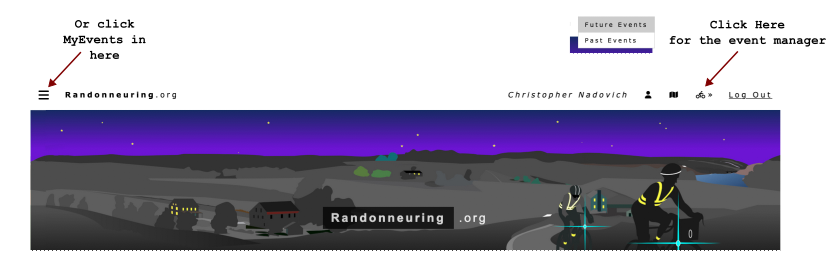
The Event Manager is the main work area of randonneuring.org. To begin managing your events, click on the events icon on the upper right, or choose "My Events" in the hamburger menu.
Creating an event is easy -- you click the PLUS sign next to "Add Future Event" and basically just fill out the form. Enter the basic parameters of your brevet like the name of the event (without the distance), the distance (separately), ACP vs RUSA sanction, offical distance, start time etc... Most importantly, enter the URL for the RWGPS route. You can come back here to edit your event details should they change. Remember, if you change the RWGPS link, you'll need to come back here to enter the latest route, then fetch and re-validate everything.
Once you've entered the basics for the event and saved out of the event editor, the buttons in the event table offer several things you can do with your event.
- Route Processor The CueWizard Route processor takes a RWGPS route and makes it usable by the eBrevet app. CueWizard will also produce quality paperwork for your route to distribute at your event, including cue sheets, brevet cards, and more.
- Roster Manager Manage rider registration for your event, and produce necessary paperwork (waivers, cuesheets, brevet cards, postcards, ... in a variety of formats.)
- Generate Outputs One benefit of entering your events and routes into randonneuring.org is the ability to automatically generate a myriad of outputs, reports, and other mashups of the event/route data. These include quality cue sheets, official brevet cards, signup sheets, CSV downloads, and support for eBrevet.
- Share Pages Another benefit of entering your events and routes into randonneuring.org are the automatically generated web pages and JSON objects that can be incorporated, shared, or linked at your club website.
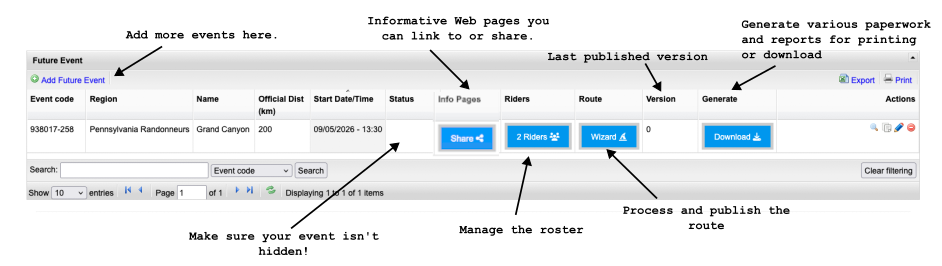
Usually the first thing you'll want to do after entering an event (with route) is to "publish" the route and paperwork. This includes publication of the cue sheet, brevet cards, and the control information for use by eBrevet. Publishing is accomplished by the Cue Wizard page, described below. After your event is created with all the details set (especially the link URL to the mapped route!), you should click the special Route Processor (Cue Wizard) icon that looks like this: . You'll now be at a page that will allow you to fetch, validate, preview, and publish your route to the event. Once published, all the data for the event and route is ready to be made available on the randonneuring.org website and in eBrevet. NB: New events are hidden by default. You'll need to go to the event manager and remove "Hidden" from the status for the published event to be fully visible. The event isn't visible to the public until it's "un-hidden" and published. These are two separate steps. By default new events are hidden. That way people don't see your event till you are ready for them to see it. Usually you want to get all the details settled, cross the tees, dot the i's.
Cue Wizard Route Processor
In order to use your randonneuring route with the tools here at randonneuring.org, you need to make your route compatible with our Cue Wizard Route Processor. Cue Wizard supports route data entry into the eBrevet app and the production of route paperwork (brevet cards and cue sheets). Currently only the mapping tool Ride With GPS route data format is supported. Other mapping tool interfaces are planned.
Making your route compatible with CueWizard is easy. Minimally, this requires having a custom cue entry for each Control checkpoint, and marking that custom cue as "Control" type. This is similar to what RUSA requires for their route library. Beyond marking controls in this way, CueWizard requires additional markup #tag=value settings that can be placed in the cue Description field. Markup tags include support for control questions, address/phone of the control contact, and other options. The cue "Notes" can be anything, but Cue Wizard uses special search/replace abbreviations to simplify these notes when printed on cue sheets.
Without these required additions, the route can't be published at randonneuring.org. Cue Wizard only works if the route is properly set up in RWGPS. If you choose a route that's not yet been set up, you'll likely see some errors and you won't be able to generate or publish anything. No worries. That's normal. Just mark controles and add control cue description #tags yet. Read the errors, and consult the Cue Wizard documentation. They'll help guide you toward what you need to add to your RWGPS route in order to make it work. Don't forget to fetch again after making RWGPS changes.
The first time you visit Cue Wizard for a given route, the Wizard will automatically fetch the route data from the RWGPS site and store a local copy with randonneuring.org. If you make changes at RWGPS, those changes will not be available to the Route Processor till you fetch the data again. Don't forget to fetch an updated route after changing it in RWGPS.
Once you have fixed all the errors and fetched the latest RWGPS data, you can preview the paperwork for the event (cue sheets, brevet cards, etc...). Very often you will notice more errors when you look over the paperwork. No worries. That's normal. Fix them and fetch again. Then, once you are SURE you have fixed all the errors, it's time to publish the route.
For more information, read the documentation of CueWizard.
Roster Manager
With the roster of your event in the event manager, many "per-rider" functions and outputs become possible. Not only does the roster contain the riders name and ID information, the roster also holds the official rider results for the event (eg: finish time). Automatically saved rider checkins and finish results uploaded from eBrevet require a roster in the event manager. And, of course, official results upload by CSV file require the roster with results.
The Riders button in the event table allows you to manage the rider roster for your event.
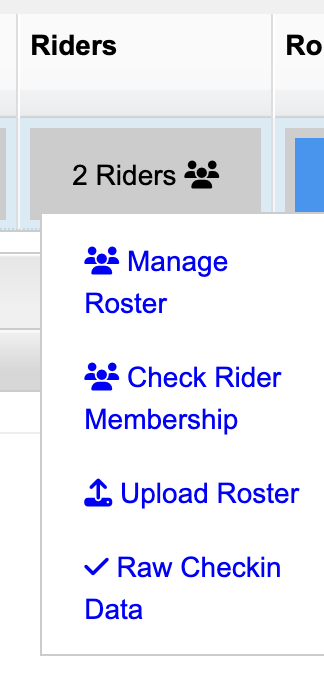
There are two ways to enter a roster into your event. You can add riders individually through the "Manage Roster" table, or you can upload a CSV file that contains your complete roster.
The manual roster manager allows you to add/edit/remove riders individually. Riders added must be RUSA members in order for them to be entered manually. The system will autocomplete the rider name as you enter it using the RUSA membership data (updated once per day by RUSA).
The CSV file upload expects a format compatible with Card-O-Matic and other systems. The CSV file must have a first-row header giving column names. Column RIDERID is required. Coulumn LAST is required if your region has membership vetting (eg Randonneurs USA / RUSA). Valid Columns (may be in any order) are:
- "RIDERID" or variations ("rider id", "rusa", "rusa number", "member", "acp", etc)
- "FIRST" or variations ("firstname", "first name", etc)
- "LAST" or variations
- "ADDRESS" or "STREET" (multiples combined, eg address1, address2...)
- "CITY"
- "STATE"
- "ZIP"
Uploading a roster erases any previous roster, however if a rider has a FINISH time result, that result will be preserved -- useful if there were preriders before the final roster is uploaded.
Generate Outputs
The "Generate" functions save time and effort for RBAs and organizers. Here you will find functions that automatically generate the various paperwork and data objects that are needed by randonneuring events. With little more than a click of the mouse, you can produce
- Sign In Sheets
- Cue Sheets
- Brevet Cards
- Waivers
- Postcards
- Results File (CSV)
These outputs are generated using the roster information, so you can get all the brevet cards, waivers, postcards, and roster sheets automatically pre-printed with the rider names. Cue sheets can be landscape or portrait, and use traditional abbreviations and other formatting enhancements making them far superior to the basic cuesheet you get from Google or RWGPS route maps. With the roster updated with rider finish times, an official results CSV file is available for upload.
Sharable Pages and JSON for your Club Website
With your event published at randonneuring.org, if you so desire you can put links on your club/regional web page that direct people to the event info and roster info pages at randonneuring.org. Some of these links are visible under the Info button. You can link to these pages or include them in your site. CSS markup can be adjusted through the Region Manager, so you can make these pages look more like your club website. There are also JSON objects that reflect all the public data available through randonneuring.org. The JSON can be used to generate your own views and mashups of the data.
The direct URLs to link include
- Past and Future Events for your region: https://randonneuring.org/regional_events/
<ACP CLUB CODE> - Future Events JSON format: https://randonneuring.org/ebrevet/future_events/
<ACP CLUB CODE> - All info about a specific event: https://randonneuring.org/event_info/
<EVENT CODE> - All info about a specific event (JSON): https://randonneuring.org/event_info/
<EVENT CODE>/json - Rider roster and results: https://randonneuring.org/roster_info/
<EVENT CODE> - Control check ins: https://randonneuring.org/checkin_status/
<EVENT CODE> - Control check ins (JSON): https://randonneuring.org/checkin_status/
<EVENT CODE>/json
where the <EVENT CODE> is the unique identifying code for the event that combines
your ACP Club Code with an event ID number (eg 905106-123). These event codes
can be seen listed in the event manager and elsewhere on randonneuring.org.
If you don't like the style of these pages, you can use the advanced 'style_html', 'header_html', and 'footer_html' fields
in the region settings to tune the styling of the pages to match your home website. Or, alternatively, fetch
the event_info/<EVENT CODE>/json for your event and
construct your page from this data. The complete JSON info includes event info, roster, control details, and checkins all in one JSON object.
Privacy
See the Privacy Policy.For Developers
The software for the Randonneuring.org website is written in PHP and requires the CodeIgniter 4 framework as well as the FPDF library GroceryCRUD Library, and hosting support for a MySQL database. The source code for this website is available for free download under the terms of the GNU Affero General Public License.
LICENSE
Copyright (C) 2026 Chris Nadovich
This program is free software: you can redistribute it and/or modify it under the terms of the GNU Affero General Public License as published by the Free Software Foundation, either version 3 of the License, or (at your option) any later version.
This program is distributed in the hope that it will be useful, but WITHOUT ANY WARRANTY; without even the implied warranty of MERCHANTABILITY or FITNESS FOR A PARTICULAR PURPOSE. See the GNU Affero General Public License for more details.